The problem
The same shapes of UI bug kept showing up on different screens, and reviewers had no way to catch all of them consistently.
Widget Blueprints are easy to author and hard to audit. Across the project, the same defect patterns kept surfacing on different screens: text that clipped once the large-text accessibility setting was on; localization overlap in longer-worded languages; hidden widgets still accepting focus; delegate bindings never unbound; inconsistent style tokens between screens built by external partners. Individually small, together they added up to a steady drip of Jira tickets.
Code review couldn't scale to catch them. Reviewers didn't have time to open every widget, simulate every text scale, walk every event-graph binding. Rare edge cases (large text, long locales) were the ones falling through, exactly the ones a human reviewer is worst at.
Standards were understood. They weren't enforced. Nothing about that is a quality problem, it's a scaling problem.
Constraints
Two surfaces
In-Editor for authors while they build, and CLI for pre-merge automation and Copilot-driven review. Same ruleset, same output.
Zero authoring friction
If it slows down save, PIE, or hot reload, adoption dies. Findings must be one click away, and one click away from the offending widget.
Grounded in real bugs
Every rule must trace back to at least one bug the team actually shipped. Rules from opinion don't survive review pushback.
Extensible by anyone
Rules ship as data. Anyone should be able to add a rule when a new pattern shows up in Jira, without a plugin rebuild.
The key idea
Mine the bug database. Turn recurring patterns into deterministic checks. Surface them in the same place authors work.
The system is three cooperating pillars: a bug-DNA knowledge base mined from 100+ Jira tickets into 17 patterns across 6 categories; an AI-driven checklist generator that consumes widget-tree JSON and produces context-aware review checklists; and a deterministic linter (22 rules covering both the widget tree and the event graph) that runs inside the Editor and as a CLI. The three share the same knowledge base, so every deterministic rule and every checklist item is rooted in a real historical bug.

Production highlights
C++ / Python split by strength
C++ owns Editor integration, traversal, and asset resolution (via a shared UIPythonCppBridge). Python owns rule authoring, tests, and CLI. Rules ship as JSON data, not builds.
Six real bug categories
Layout/Scaling, Styling/Consistency, Text/Localization, Visibility/State, Input/Navigation, Data Binding, distilled from a Jira mining pass over the project's real defect history.
Findings where authors work
Widget-tree hits jump to the offending widget in the Hierarchy panel; event-graph hits jump to the exact node. Fix suggestions include one-click Fix → Widgets actions for uncategorized variables and dead code.
A rule authoring loop, not a fixed set
Add New Rule launches Copilot CLI with the current widget as context, drafting a candidate rule from a real example. The 22-rule count grew over months as new patterns showed up in Jira.
The showcase rule, L001
L001, text-in-fixed-container, is the rule that made the case for the whole
tool. It flags any text block placed inside a fixed-width container without an auto-size or
wrap contract. The pattern comes straight from the Layout/Scaling category, and it's the
exact class of bug that used to surface only after QA turned on large-text accessibility or
switched to a longer locale.
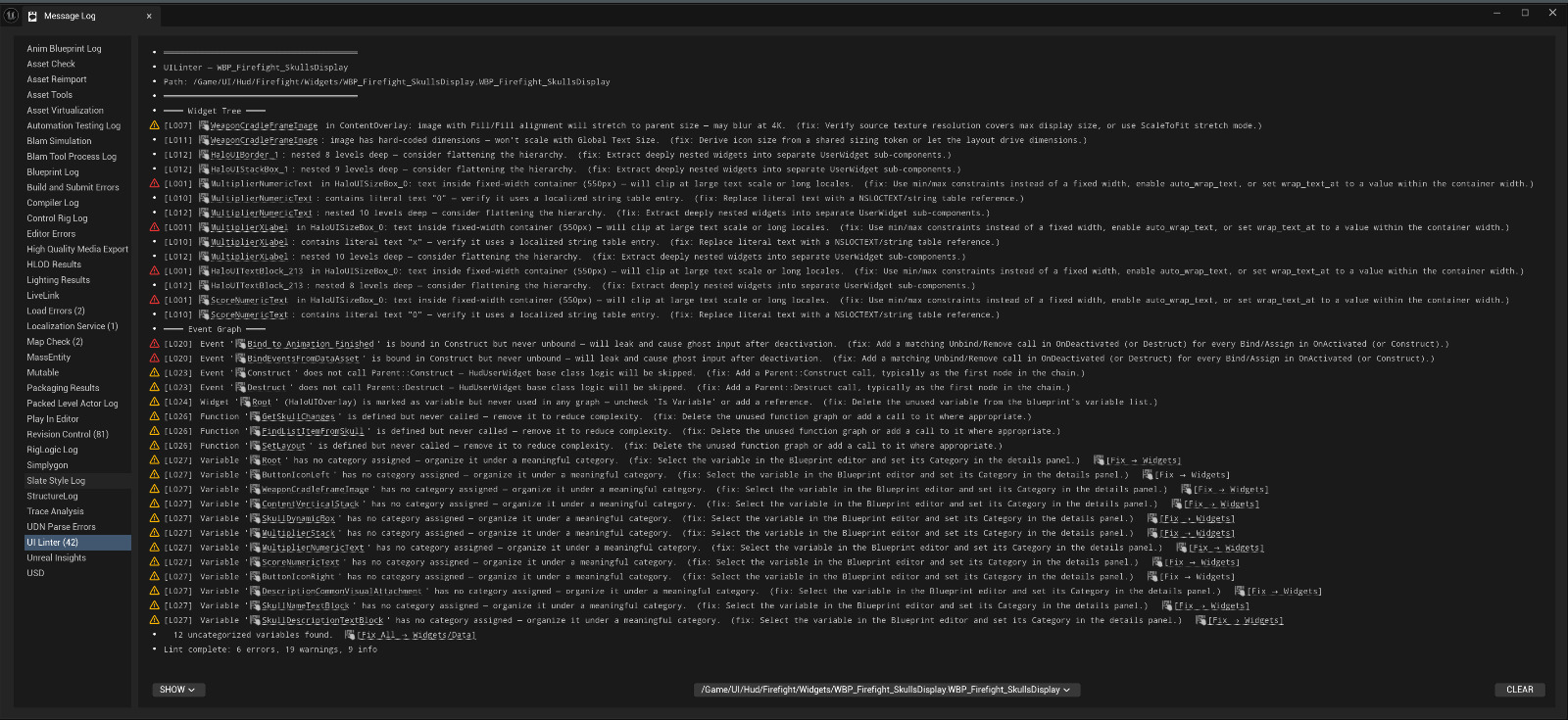
In practice: a single lint pass on the pictured skulls-display widget above surfaces
several L001 hits alongside binding-leak (L020) and dead-code
(L026 / L027) findings. Each one is a bug that would previously have shipped
to QA before anyone noticed.
What I'd carry forward
- Rules from bugs, not opinion. Mining Jira first gave every rule a defensible provenance. When someone pushed back on a rule, the answer was "this is bug MTR-####" — hard to argue with.
- Auto-fix changed adoption behavior. A warning with a Fix button becomes a habit. Warnings without one become noise.
- The review process changed, not just the code. Once PRs included a linter screenshot as an evidence artifact, the tool stopped being optional in social practice.
- AI-assist for rule authoring is what let the system grow. A solo owner can't hand-maintain 22 rules and their fixtures indefinitely. Copilot-drafted rule scaffolding lowered the cost of adding the twenty-third.